When I worked as a NetSuite consultant, I saw a business spend its savings on the software after the salesperson took 50% off. The day after go-live, they needed a workflow changed. The consultant rate was $250 an hour, and they couldn’t afford it.
That’s often the moment owners start looking up netsuite alternatives australia. For each option below, I’ve noted what it costs and who makes the changes once you’re live.
TL;DR for netsuite alternatives australia: The six options worth comparing are Clevero, MYOB Acumatica, Microsoft Dynamics 365 Business Central, Wiise, Odoo and Xero with add-on apps. Clevero suits Australian service businesses that want CRM, jobs, billing and workflows in one platform their own team can change, with native Xero and MYOB. Business Central, Wiise, Odoo and Xero publish prices; Clevero, MYOB Acumatica and NetSuite quote on request. NetSuite is still the right fit for businesses with several entities, heavy inventory or operations in many countries.
6 Best NetSuite Alternatives at a Glance
Here is a quick comparison of the netsuite alternatives in Australia for those who are short on time:
| Tool | Best for | Accounting | Who usually sets it up | Pricing (Nov 2026) |
| Clevero | Service businesses that want one platform they can change | Native Xero and MYOB | Clevero, then your own team | Quote only |
| MYOB Acumatica | Growing businesses that want a full ERP from an Australian brand | Built in | An MYOB partner | Quote through a partner |
| Business Central | Businesses already on Microsoft 365 | Built in | A Microsoft partner | From AU$119.70 per user a month, paid yearly |
| Wiise | Australian product businesses with stock and warehouses | Built in | Wiise or its partners | From A$158 per full user a month, ex GST |
| Odoo | Businesses that want to add one app at a time | Built in (Accounting app) | You or an Odoo partner | One app free; paid plans shown to me in USD |
| Xero plus apps | Smaller teams that mainly need accounting | Built in | You or your bookkeeper | From $107 a month (Comprehensive) |
Quick pick:
- If you’re a service business running jobs, clients and billing on spreadsheets around Xero or MYOB → look at Clevero.
- If you’re already on MYOB and need a full ERP → look at MYOB Acumatica.
- If you hold stock, run a warehouse or live in Microsoft 365 → look at Wiise or Business Central.
- If you mainly need accounting and a few add-ons → look at Xero.
My first pick among these netsuite alternatives for Australian SMEs is Clevero, because your own team can change how it works after go-live, and it keeps Xero or MYOB as your books. If you make or ship physical products in volume, start with MYOB Acumatica, Wiise or Business Central instead.

Why businesses look for NetSuite alternatives
NetSuite is a strong ERP. Reviewers praise how far you can customise it and how well it scales. The reasons people give for looking elsewhere tend to be about fit:
- Most businesses use a small part of it. From what I saw implementing enterprise software, most teams use maybe 20% of what they pay for. You don’t buy a Ferrari to drive it like a Corolla.
- Changes after go-live cost money. Bigger changes often go to a partner or a consultant, billed by the hour, which is how that business ended up stuck.
- Some connections cost extra. One reviewer described exporting sales from their POS systems and importing them back by hand, because the link needed extra software.
- It takes NetSuite knowledge to get the most out of it. The same reviewer said custom reports were hard to build without knowing the system already.
The 6 Best NetSuite Alternatives for Australian SMEs
1. Clevero
Best for: Australian service businesses that want CRM, jobs, billing and workflows in one platform their own team can change.
Price: quote only, based on the modules you use (checked in November 2026).
Watch out for: Clevero isn’t built for manufacturing or warehouse-scale inventory. If that’s the core of your business, look at Wiise, Business Central or MYOB Acumatica.
I built Clevero after that $250-an-hour moment. It’s a configurable business management platform: CRM, quoting, projects and timesheets, forms, e-signatures, recurring billing and workflow automation, all in one place. Each business shapes the records it keeps, so a consultancy and a clinic can run very differently on the same platform.
Your team changes how it works, point-and-click. When a step in your process changes, your ops manager can change the workflow without a ticket or a consultant’s quote. Our internal saying is that if you can do it in the system through the UI, it can be automated. If you run more than one service line, each can have its own workflow in the same system.
As a NetSuite alternative, Clevero keeps your accounting where it is. It connects natively with Xero and MYOB, so invoices and payments sync without re-keying, and every change is logged as your team works, which gives you an audit trail without a separate record. We also help with data migration when you move across.
Pros
- Workflows, forms and automations your own team changes
- Native Xero and MYOB, so your accountant keeps their setup
- One platform for more than one service line
- Audit trail built as your team works
Cons
- No published price; you need a call to get a quote
- Not built for manufacturing or stock-heavy ERP work
Pricing: quote only, based on the modules you use.
Also read: Hello Mello customer success story
2. MYOB Acumatica
Best for: growing Australian businesses, especially MYOB users, that need a full cloud ERP.
Price: quote only through an MYOB partner, licensed per named user in Australia and New Zealand (checked in November 2026).
Watch out for: licence, implementation and support are quoted by the partner, so ask for each as a separate line.
MYOB Acumatica is the new name for MYOB Advanced, so if you’ve heard the old name, it’s the same product. It runs on Acumatica’s cloud ERP and covers financials, inventory, distribution, projects and manufacturing, sold and supported in Australia through MYOB and its partners.
For a business that has outgrown MYOB Business, it’s a natural step, because the brand and the local partners stay familiar. It’s one of the closest like-for-like netsuite competitors here, so expect an ERP-style project to set it up.
Pros
- Full ERP, including inventory and manufacturing
- Australian brand with local partners
- Easy step up for MYOB users
Cons
- No public price; every quote comes through a partner
- Setup is a project, not a sign-up
Pricing: quote only, through an MYOB partner.
3. Microsoft Dynamics 365 Business Central
Best for: small and mid-sized businesses already on Microsoft 365 that want an ERP next to Outlook, Teams and Excel.
Price: Essentials AU$119.70 and Premium AU$164.60 per user a month, paid yearly; Team Members AU$12 per user a month (checked in November 2026).
Watch out for: in Australia, setup and support come from Microsoft partners, so compare partners as well as the software.
Business Central is Microsoft’s ERP for small and mid-sized businesses, and in Australia it’s sold and set up through Microsoft partners. It covers financials, sales, purchasing, inventory, projects and reporting, and it works with Outlook, Excel and Teams.
Premium adds manufacturing and service management. Team Member licences let staff who only need to read or approve work in the system at a lower price, which helps if only a few people do the heavy lifting.
Pros
- Published AUD prices
- Works with the Microsoft 365 tools your team already uses
- Cheaper licences for light users
Cons
- Partner fees for setup sit on top of the licence
- Full user licences add up as the team grows
Pricing: from AU$119.70 per user a month, paid yearly.
4. Wiise
Best for: Australian product businesses with stock, warehouses and job costing that want a local ERP.
Price: Business A$158 and Premium A$210 per full user a month; Team Members A$23.50 per user; ex GST (checked in November 2026).
Watch out for: full users are priced per person, so work out how many staff need full access before you compare.
Wiise is built in Australia on Microsoft Dynamics 365 Business Central and is aimed at businesses that have outgrown small business accounting. The Business plan covers accounting, inventory, warehousing and distribution, CRM, and projects and job costing.
If you like the Business Central idea but want a local company to deal with, Wiise is worth putting next to it. It also lists discounted pricing for not-for-profits and education.
Pros
- Australian company with AUD pricing on its site
- Inventory, warehousing and job costing included
- Not-for-profit and education discounts
Cons
- Per-user pricing for full users
- More ERP than a small service business needs
Pricing: from A$158 per full user a month, ex GST.
5. Odoo
Best for: businesses that want to start with one app and add more as they grow.
Price: One App Free (one app, unlimited users); Standard and Custom plans priced per user a month, shown to me in USD (checked in November 2026).
Watch out for: you need the Custom plan for Odoo.sh or on-premise hosting, and many businesses bring in an Odoo partner for setup.
Odoo is open-source business software with apps for accounting, CRM, inventory, projects, manufacturing, websites and more. You can start free with a single app, then move to Standard for all apps.
It can be a cheaper alternative to NetSuite on paper, because you pay per user and only for what you switch on. The real cost depends on how much setup and customising you need, so ask a partner for a quote before you compare.
Pros
- Free single-app plan with unlimited users
- Very wide range of apps
- Pay only for the plan and users you need
Cons
- Prices shown to me in USD
- Larger setups usually need a partner
Pricing: One App Free; paid plans per user a month.
6. Xero plus add-on apps
Best for: small teams whose main need is accounting, with a few apps for stock, jobs or CRM.
Price: Comprehensive $107, Ultimate 10 $143, Ultimate 20 $180 and Ultimate 50 $250 a month at regular prices (checked in November 2026).
Watch out for: Xero is accounting first, so stock, jobs and CRM come from add-on apps you connect and pay for separately.
For a lot of businesses looking at netsuite alternatives for small business, the honest answer is Xero plus one or two apps. Xero covers invoicing, bills, bank feeds, expense claims and, on its higher plans, project tracking.
The Xero App Store has apps for inventory, field service, practice management and CRM. That keeps costs low, but each app is another login and another sync to look after. If that’s where you’re heading, my guide to the best CRM with Xero integration compares the options.
Pros
- Simple monthly pricing
- Familiar to most Australian accountants and bookkeepers
- Large app marketplace
Cons
- Stock, jobs and CRM need extra apps
- Each app adds a subscription and a sync
Pricing: from $107 a month (Comprehensive).
Read next: All-in-one business management software for Australian SMEs
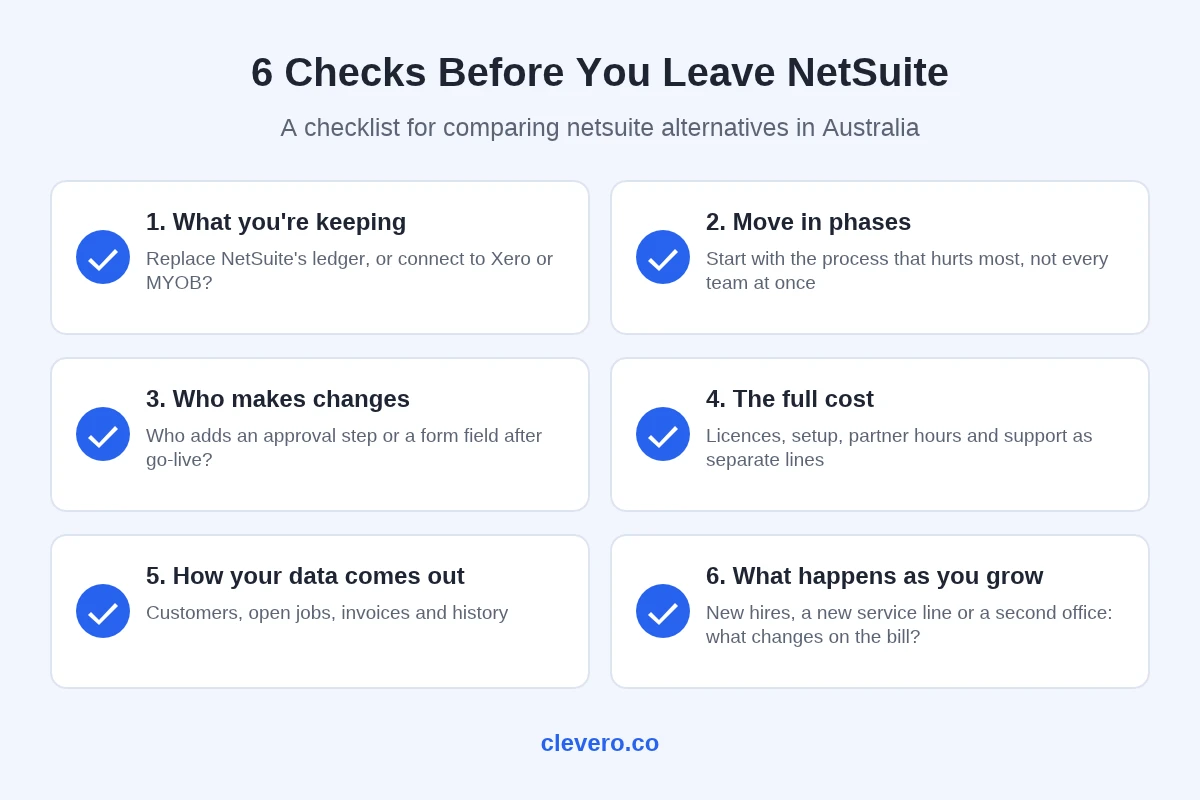
What to check before you leave NetSuite
Before you book demos with any netsuite alternatives in Australia, map how your business runs today: who does what, and in what order. Then check each option against this:
- Decide what you’re keeping. If NetSuite is your general ledger, choose whether the new system replaces it or connects to Xero or MYOB.
- Move in phases. Don’t try to switch every team at once. Start with the process that hurts most.
- Ask who makes changes after go-live. Ask for an example: a new approval step or a new form field, and who does it.
- Add up the full cost. Ask for licences, setup, partner hours and support as separate lines.
- Check how your data comes out of NetSuite. List the records you need (customers, open jobs, invoices, history) and ask each vendor how they’ll bring them in.
- Ask what happens as you grow. If you hire, add a service line or open a second office, what changes on the bill?
If you’re still deciding how much to put in one system, my post on how to reduce manual data entry covers where the hours usually go.
NetSuite vs Clevero: Which One Should You Choose
| NetSuite | Clevero | |
| Built for | Full ERP: finance, inventory, multiple entities | Service operations: clients, jobs, billing, workflows |
| Accounting | Its own general ledger | Native Xero and MYOB |
| Changing workflows | Highly customisable; bigger changes often go to a partner or admin | Point-and-click by your own team |
| Inventory and manufacturing | Yes | Not the focus |
| Pricing | Quote, based on modules and users | Quote, based on modules |
| Audit trail | Check with NetSuite | Built as your team works |
NetSuite is built to run finance, stock and several companies in one system, and for that it’s a fair choice. Clevero is built for the service business that wants its clients, jobs and billing in one place, with Xero or MYOB doing the books. If you hold stock across warehouses or report across entities, stay with an ERP. If you mostly sell time and expertise, you may be paying for a lot you don’t use.
See what’s included on the Clevero features page.
So, Which Is Best Among the NetSuite Alternatives?
If you need a full ERP, MYOB Acumatica suits businesses already on MYOB, Business Central suits Microsoft 365 shops, and Wiise is the local option with stock and warehousing built in. Odoo lets you start small with one app, and Xero with an app or two covers many small teams.
If you run a service business and the cost of change is what’s hurting, I’d look at Clevero. Whichever netsuite alternatives you shortlist, ask each vendor to change one workflow live in the demo and tell you what it would cost after go-live.

Frequently asked questions
1. What are the best netsuite alternatives in Australia?
The best netsuite alternatives in Australia are Clevero, MYOB Acumatica, Microsoft Dynamics 365 Business Central, Wiise, Odoo and Xero with add-on apps. Clevero suits service businesses that want one platform they can change themselves. MYOB Acumatica, Business Central and Wiise suit businesses that need a full ERP with inventory.
2. Why do businesses look for NetSuite alternatives?
The usual reasons are cost, complexity and the price of changes after go-live. Many smaller businesses use only part of NetSuite, and bigger changes often need a partner or consultant. Some reviewers also mention connections to other systems that need extra software.
3. What is a cheaper alternative to NetSuite?
For accounting-led small businesses, Xero with an add-on app or two is usually the lowest monthly cost. Odoo has a free single-app plan and per-user paid plans. Business Central and Wiise publish per-user AUD prices, so you can work out the licence cost before a demo. Add setup and partner fees to every quote before you compare.
4. What are the best netsuite alternatives for small business?
For a small service business, look at Clevero or Xero with add-on apps. For a small product business with stock, look at Wiise, Business Central or Odoo. MYOB Acumatica tends to suit businesses that have grown past small business software.
5. Is Business Central in Australia cheaper than NetSuite?
Business Central publishes its prices (from AU$119.70 per user a month, paid yearly, in November 2026), while NetSuite quotes on request, so you can’t compare on list price alone. Ask both for a full quote with licences, setup and support, for the same number of users.
6. What is the difference between MYOB Acumatica and NetSuite?
Both are cloud ERPs with financials, inventory and projects. MYOB Acumatica (formerly MYOB Advanced) is sold and supported in Australia through MYOB partners and is licensed per named user here. NetSuite is owned by Oracle and sold directly and through partners. Ask both for a demo built on your own processes.
7. Can Clevero replace NetSuite?
For a service business, yes, often. Clevero runs CRM, jobs, projects, billing and workflows, and uses Xero or MYOB for the books. If you rely on NetSuite for manufacturing, warehouse inventory or reporting across several entities, keep an ERP. Clevero can still run the client and job side next to it.