

Halaxy keeps your appointments and claims moving. But when you want to know which GPs send you the most clients, or which enquiries never booked, you end up in a spreadsheet. That might be why growing practices look at Halaxy alternatives, or at something to run alongside Halaxy.
For each option below, I’ve noted what it costs, what it tracks beyond the diary, and who makes changes when your clinic grows.
TL;DR for Halaxy alternatives: The seven options worth comparing are Clevero, Cliniko, Zanda (formerly Power Diary), Nookal, Splose, Coreplus and Jane. Clevero suits practices that need CRM, referrer and enquiry tracking alongside or instead of Halaxy, in a platform they can change themselves. Cliniko, Zanda, Nookal, Splose, Coreplus and Jane publish prices; Clevero quotes on request. Halaxy is still a fair choice for a solo practitioner who wants free core software and doesn’t mind paying per use for SMS and claims.
7 Best Halaxy Alternatives at a Glance
Here is a quick comparison of the best Halaxy alternatives for those who are short on time:
| Feature | Cliniko | Zanda | Nookal | Splose | Coreplus | Jane | Clevero |
| Claiming | Integration with Tyro Health | Medicare via Tyro | Medicare (per claim) | NDIS bulk upload, DVA | Medicare and DVA included | Yes | Via Tyro Health |
| Accounting link | Xero | Xero | Xero, MYOB export | Two-way Xero | Xero add-on | No direct sync | Native Xero and MYOB |
| Referrer tracking | Referring doctors | Referrer profiles | Referrer letters | Referral letters | Referrals feature | Ask | Yes, with reports |
| Enquiries before booking (CRM) | No | No | No | CRM module | No | No | Yes |
| Change workflows yourself | Yes, but needs integrations for complex workflows | Comms automations | Coming soon | Automations | Yes | Yes | Yes, point-and-click |
| Pricing (Nov 2026) | From US$45/mo | From $29/mo | From ~US$41 per practitioner/mo | A$32 per practitioner/mo | From A$35 per user/mo | From US$59/mo | Quote only |
My first pick among these Halaxy alternatives is Clevero. Because it tracks the people around the booking (referrers, enquiries and follow-ups) and your own team can change how it works. If you only need a cheaper or simpler diary and claims tool, Cliniko or Coreplus will get you there faster.

Practices to Look for Before Considering Halaxy Alternatives
Halaxy has happy users too: a 2025 review on the Xero App Store praises its support and the free price. The reasons people give for leaving are more specific:
- The monthly cost is hard to predict. The core software is free, but SMS, Medicare, DVA, NDIS and HICAPS claims, telehealth, e-scripts and AI Scribe all use credits (A$0.15 to A$0.22 each, including GST, on Halaxy’s pricing page). One reviewer said the credit system was hard to reconcile.
- Reliability and support. A review from mid-2026 describes reminder and invoice emails not arriving, PDF generation failing, and slow answers from support.
- Getting your records out. A review from April 2026 says client notes were only exported as editable .html files.
- Privacy terms. Some practitioners have questioned what Halaxy’s privacy policy allows it to do with data. Read the policy yourself before you decide.
The 7 Best Halaxy Alternatives for Australian Practices
1. Clevero
Best for: allied health practices that need CRM, referrer and enquiry tracking alongside or instead of Halaxy, in one platform their team can change.
Price: quote only, based on the modules you use (checked in November 2026).
Watch out for: if you need clinical notes in the same system, confirm in a demo how Clevero works with your clinical record.
A practice management system is built around the diary. Clevero is built around the relationships that fill it. For allied health practices, it covers website bookings, client and health records, telehealth, SMS and email reminders, and claiming and invoicing. Its CRM records the enquiry from your website, the GP or specialist who referred the client, the follow-up that’s due and what happened next.
So you can see which referrers send the most clients and which enquiries never booked.
Your team changes how it works, point-and-click. Intake steps, forms, reminders and automations can be edited by your practice manager without waiting on a vendor. If you run more than one service line, say a clinic plus NDIS services or group programs, each can have its own workflow in the same system.
As a Halaxy alternative, Clevero can also sit alongside a clinical system. It connects with Medipass, Tyro, Medicare, Medirecords and eRx, and natively with Xero and MYOB, so invoices and payments reach your books without re-keying. Every change is logged as your team works, which gives you an audit trail without keeping a separate record.
Pros
- Tracks referrers, enquiries and follow-ups, not just appointments
- Workflows, forms and automations you change yourself
- Native Xero and MYOB, plus Medipass, Tyro and Medicare connections
- One platform for more than one service line
- Audit trail built as your team works
Cons
- No published price; you need a call to get a quote
Pricing: quote only, based on the modules you use.
2. Cliniko
Best for: clinics that want a simple, reliable PMS with flat pricing by practitioner count.
Price: from US$45 a month for 1 practitioner, US$95 for 2 to 5, up to US$395 for 26 to 200 (shown in USD, checked in November 2026).
Watch out for: the price steps up at each practitioner bracket, so check where your headcount will land in a year.
Cliniko is an Australian PMS with a long record in physio, chiro and other allied health clinics. It covers the diary, online bookings, treatment notes, invoicing and reminders, and it has a 30-day free trial. Its help guide shows you can assign a referring doctor to a client and track referral details in patient cases.
On halaxy vs cliniko, the main difference is the pricing model: Halaxy is free at the core with credits for extras, and Cliniko is one monthly price for your practitioner bracket. If you’d rather know your bill in advance, that alone may decide it. I’ve covered Cliniko’s own competitors in my Cliniko alternatives guide.
Pros
- Flat monthly price by practitioner bracket
- 30-day free trial
- Referring doctor tracking inside patient cases
Cons
- Brackets mean a jump in price when you add one practitioner past the limit
- Referrer tracking sits in patient cases, so check how it handles enquiries before they book
Pricing: from US$45 a month (1 practitioner) to US$395 a month (26 to 200 practitioners).
3. Zanda (formerly Power Diary)
Best for: solo and small practices that want low entry pricing and built-in AI tools.
Price: Starter from $29 a month; Growth $49 a month plus $29 per extra practitioner; half price for the first 6 months
Watch out for: SMS, telehealth beyond 4 free sessions, and insurance claiming add small extra charges, so add them up for your volume.
Zanda is the new name for Power Diary, so if you knew the old brand, it’s the same company. It covers bookings, client records, notes, invoicing and automations for intake, billing and recalls, with BizzyAI tools including an AI scribe (4 appointments per practitioner a month on the base plan).
In Australia, Zanda works with Tyro for terminal payments and private health and Medicare claims, and it connects with Xero. Its pricing page says data migration and support are free.
Pros
- Low starting price with a 6-month discount
- Free data migration and support
- Tyro integration for payments and claims
Cons
- Add-ons (SMS number, Telehealth Pro, claiming fees) raise the real monthly cost
- The intro price doubles after 6 months
Pricing: Starter $29 a month; Growth $49 a month plus $29 per extra practitioner.
4. Nookal
Best for: multi-practitioner clinics that want the per-practitioner rate to drop as they grow.
Price: Essentials about US$41 and Professional about US$44 per practitioner a month at 6 practitioners; Enterprise on quote (shown in USD, checked in November 2026).
Watch out for: Medicare claiming is charged per claim (US$0.10 to US$0.30, depending on plan), and text reminders are extra.
Nookal is an Australian PMS built for allied health. Its pricing is per practitioner, each extra practitioner costs less than the one before, and admin and reception staff are free. Essentials covers bookings, multi-practitioner scheduling, records, invoicing, intake forms and Medicare integration.
Professional adds KPI dashboards, automated recalls and waitlists, two-way SMS and quoting tools. There’s a 30-day free trial with no lock-in contract.
Pros
- Per-practitioner rate drops as your team grows
- Admin and reception staff at no cost
- 30-day free trial, no lock-in
Cons
- Per-claim and per-text fees on top of the subscription
- AI assistant and patient portal are paid add-ons
Pricing: per practitioner, from about US$41 a month at 6 practitioners.
5. Splose
Best for: allied health practices with a lot of NDIS work that want NDIS bulk upload and two-way Xero.
Price: A$32 per practitioner a month, ex GST; non-practitioner roles free (checked in November 2026).
Watch out for: SMS, payments and the AI tools are priced separately from the platform fee.
Splose is an Australian PMS used by allied health teams, and it leans into NDIS work: service agreements, case tracking, utilisation and expiry reminders, and NDIS bulk upload for claims. It also handles third-party billing and DVA claiming.
It has a certified two-way Xero integration for invoicing and reconciliation. There’s a 14-day free trial.
Pros
- NDIS bulk upload and service agreement tracking
- Two-way Xero integration
- Non-practitioner roles at no cost
Cons
- Extras (SMS, payments, AI) are added on top
- Shorter free trial than Cliniko or Nookal
Pricing: A$32 per practitioner a month, ex GST.
6. Coreplus
Best for: practices that want Medicare and DVA claim processing included in the plan.
Price: CORE A$35 and PLUS A$49 per user a month, ex GST; GROUP (8+ users) on quote (checked in November 2026).
Watch out for: pricing is per user, and SMS and some add-ons are charged per use.
Coreplus is an Australian PMS for allied health, with plans for small practices and larger groups. It covers bookings, notes, invoicing and NDIS features.
Its pricing page lists free Medicare and DVA claim processing, which matters if a big share of your clients claim. If you’ve been paying credits for each claim on Halaxy, compare the per-user fee against what you spend on claims now.
Pros
- Medicare and DVA claim processing included
- Clear AUD pricing on the vendor’s site
- NDIS features
Cons
- Per-user pricing adds up for larger teams
- SMS (A$0.10 to A$0.15 each) and telehealth minutes are charged per use
Pricing: A$35 or A$49 per user a month, ex GST.
7. Jane
Best for: clinics that want polished online booking and a smooth client experience.
Price: Balance from US$0 (1 practitioner, 20 appointments a month), Practice from US$59 and Thrive from US$99 a month, plus per-practitioner fees (shown in USD, checked in November 2026).
Watch out for: Jane is a Canadian company, so check how it handles Australian claiming before you commit.
Jane covers online booking, charting, telehealth and payments for physio, massage and multidisciplinary clinics. The plans scale with appointment volume and practitioners, and the AI Scribe is an add-on.
It has a free plan for very small practices. For an Australian clinic, ask how Medicare, DVA and NDIS claiming work in practice.
Pros
- Strong online booking and client experience
- Free plan for very small practices
- Large chart template library
Cons
- Prices shown in USD
- Check Australian claiming before you switch
Pricing: from US$59 a month on Practice, plus per-practitioner fees.
Read next: 7 Best Cliniko Alternatives in Australia
What to check before you switch from Halaxy
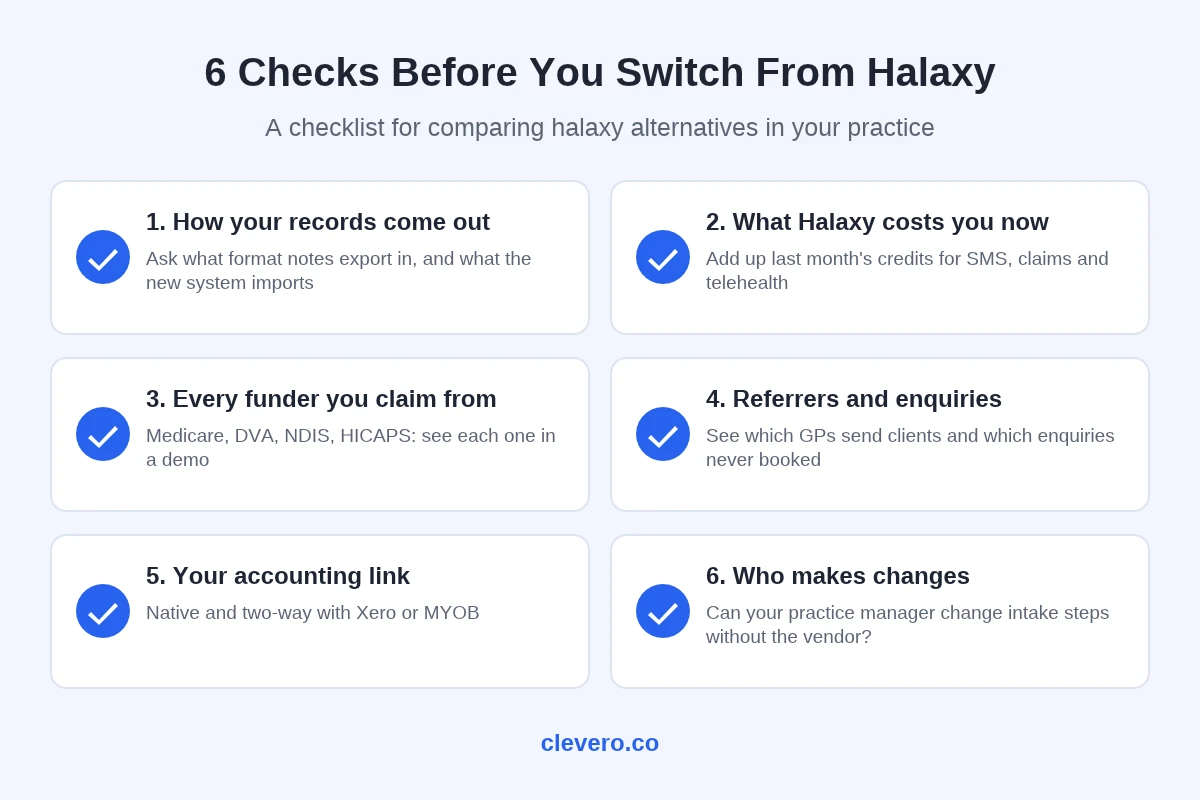
Before you book demos with any halaxy alternatives, list what your practice does in a normal week. Then check each option against this:
- Ask how your records come out. Find out what format Halaxy exports notes in, and what format the new system can import.
- Work out what Halaxy really costs you now. Add up last month’s credits for SMS, claims and telehealth, and compare that with each vendor’s monthly price plus its own extras.
- Check claiming. List the funders you claim from (Medicare, DVA, NDIS, HICAPS, WorkCover) and ask each vendor to show you each one.
- Look at referrers and enquiries. Can you see which GPs send you clients, and which website enquiries never booked?
- Check your accounting link. Ask whether Xero or MYOB is native and two-way.
- Ask who makes changes. When your intake process changes, can your practice manager change it, or does it go to the vendor?
If you’re still working out whether you need a PMS, a CRM or both, my guide to allied health practice management software vs CRM explains the difference.
Halaxy vs Clevero: Which One Should You Choose
| Halaxy | Clevero | |
| Built around | The diary, notes and claims | Clients, referrers, enquiries and workflows |
| Pricing | Free core, credits for extras | Quote, based on modules |
| Referrer and enquiry tracking | Check with Halaxy | CRM for referrers, enquiries and follow-ups |
| Changing workflows | Check with Halaxy | Point-and-click by your team |
| Accounting | Xero integration | Native Xero and MYOB |
| Clinical notes | Yes | Confirm in a demo (can sit alongside your clinical system) |
| Audit trail | Check with Halaxy | Built as your team works |
Halaxy runs the clinic: the diary, notes and claims, for free at the core. Clevero runs the relationships around it, and you can run both. If your diary is full and referrals take care of themselves, Halaxy may be all you need. If you’re hiring admin just to chase follow-ups and track referrers, that’s the work Clevero is built for.
Read next: My guide to allied health practice management
So, Which Is Best Among the Halaxy Alternatives?
If you want a simpler PMS with a predictable bill, Cliniko and Coreplus are the safe picks, and Coreplus includes Medicare and DVA claim processing. Splose fits practices with a lot of NDIS work, Nookal fits clinics adding practitioners, and Zanda is the cheapest place to start.
If what you’re missing is a view of where clients come from and what happens before they book, I’d look at Clevero, either in place of Halaxy or next to it. Whichever halaxy alternatives you shortlist, ask each vendor to demo the same week of your practice: a website enquiry, a GP referral, a booking, a claim and a follow-up.

Read next: Allied health practice management software vs CRM
Frequently asked questions
1. What are the best halaxy alternatives in Australia?
The best halaxy alternatives for Australian allied health practices are Clevero, Cliniko, Zanda, Nookal, Splose, Coreplus and Jane. Clevero suits practices that need CRM and referrer tracking. Cliniko and Coreplus suit practices that want a simple PMS with a set monthly price, and Splose suits NDIS-heavy practices.
2. Why do practices look for halaxy alternatives?
Reviews mention credit costs that are hard to predict, reliability and support problems, and record exports in an editable format. Some practitioners have also questioned Halaxy’s privacy terms. Plenty of solo practitioners are happy with it, mainly because the core is free.
3. Is Halaxy really free?
Halaxy’s core software is free: calendar, online bookings, email reminders, patient records, clinical invoicing and reports. SMS, funding body claims (Medicare, DVA, NDIS, HICAPS and others), telehealth, e-scripts and AI Scribe use credits, priced at A$0.15 to A$0.22 each including GST (Halaxy’s pricing page, November 2026). Payment processing is 1.5% to 1.9% per transaction.
4. Halaxy vs Cliniko: which is better?
It depends on how you want to pay. Halaxy is free at the core with credits for extras. Cliniko charges one monthly price for your practitioner bracket, starting at US$45 a month for one practitioner on the price shown to me. Both are used widely by Australian allied health clinics, and Cliniko has a 30-day free trial, so trial both with your own week of appointments.
5. Can I use Clevero alongside Halaxy?
Yes, that’s one of the setups I’d consider. Halaxy keeps your diary, notes and claims, and Clevero tracks referrers, enquiries, follow-ups and the work around them. Ask in a demo how the two would share client details for your practice.
6. How do I move my data out of Halaxy?
Ask Halaxy what export formats it offers for clients, appointments, invoices and notes, and ask your new vendor what it can import. One reviewer said notes came out only as editable .html files, so check this before you commit to a switch date.
7. Which Halaxy alternative is best for NDIS providers?
Splose has NDIS bulk upload and service agreement tracking, and Coreplus also lists NDIS features. If you run NDIS services next to a clinic and need to track participants, plans and referrals in one place, see my guide to NDIS CRM software.